
CRS-35 Dragon reaches the ISS with the station's final pair of roll-out solar arrays
SpaceX's 35th NASA cargo mission delivered more than 6,300 pounds of supplies, new experiments and the last two iROSA solar arrays to the International Space Station.
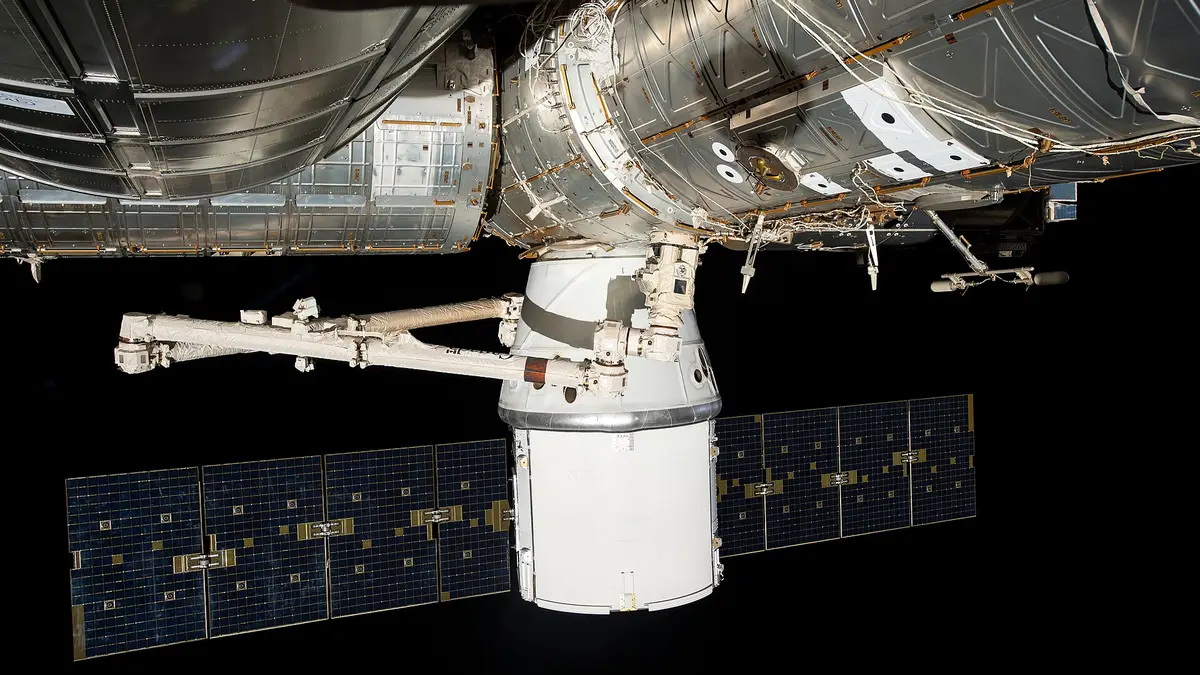
SpaceX's Dragon cargo spacecraft has arrived at the International Space Station on NASA's 35th commercial resupply mission, CRS-35. SpaceX confirmed docking on Thursday, October 15, 2026, two days after launch.
The launch
According to NASA, the mission lifted off at 6:33 a.m. EDT on Tuesday aboard a Falcon 9 from Space Launch Complex 40 at Cape Canaveral Space Force Station in Florida. Dragon carried more than 6,300 pounds of supplies and hardware for the crew of the orbiting laboratory.
NASA scheduled Dragon to dock autonomously to the space-facing port of the station's Harmony module on October 15, and streamed rendezvous and docking coverage.
The last solar arrays
The headline cargo is the final pair of International Space Station Roll-Out Solar Arrays (iROSA). NASA says these complete the station's power-system augmentation, boosting available electricity for research, operations and, notably, for the station's safe, controlled deorbit at the end of its life. Astronauts are set to install the arrays during a series of spacewalks planned for later this fall.
That deorbit reference is a reminder of where the ISS is in its lifecycle: the agency is now investing in hardware partly to make sure the station can be brought down safely, while commercial stations are being developed to take over low Earth orbit research.
The science on board
NASA highlighted several new experiments flying on CRS-35:
- Artificial retinas. Hardware to manufacture artificial retinas in microgravity that could help restore vision for patients on Earth.
- 3D heart tissue. Heart tissue models intended to advance large-scale drug testing on future space missions.
- New glass. Materials to study how a new type of glass forms in microgravity.
- Brain organoids. Organoids that could uncover potential treatment targets for neurodegenerative diseases such as Alzheimer's, Parkinson's and multiple sclerosis.
NASA notes these are a sample of the hundreds of investigations carried out on the station across biology and biotechnology, physical sciences, and Earth and space science.
Why it matters
Cargo Dragon has become routine, and routine is the point. Reliable resupply is what lets the station act as a laboratory, and each mission like CRS-35 adds evidence for in-space manufacturing ideas, from retinas to specialty glass, that commercial station operators hope to turn into businesses. For SpaceX, it is another flight in a contract business that runs alongside Starlink and Starship.
The next milestones are the spacewalks to install the new arrays and, eventually, Dragon's return to Earth with completed experiments.
.jpg)